

Deciding when to hire a CFO is one of the most consequential financial decisions a UK founder will ever make. Bring one in too early and you carry a cost your business cannot yet justify. Leave it too late and you risk poor cash decisions, a stalled fundraise, shrinking margins, or a business that grows faster than its financial foundations can bear. Get the timing right, however, and a CFO becomes one of the highest-return investments in your company’s history.
This complete guide is written for founders and business owners in the UK who sense they may need senior financial leadership but are not sure when, why, or in what form. It covers the signs that the moment has arrived, the different types of CFO you can hire, what each option costs. How a CFO adds value across growth, fundraising, margins and exit. By the end you will be able to answer, with confidence, the question so many founders wrestle with: is now the right time for us to hire a CFO?
We will move from the foundations — what a CFO actually is and does — through the practical timing signals, the stage-by-stage view from startup to exit, the fractional-versus-full-time decision, costs, the hiring process. The specific ways a CFO drives value. Throughout, you will find links to focused guides that go deeper on individual topics.
The One-Line Answer
You are ready for a CFO when the financial decisions in front of you are bigger than the financial insight behind you. When instinct alone stops being enough, it is time.
The team behind this guide


What a CFO actually is — and what they are not
Before you can decide when to hire a CFO, it helps to be precise about what the role is. A Chief Financial Officer is the senior executive responsible for the strategic financial direction of a business. That means far more than keeping the books. A CFO turns numbers into decisions: forecasting cash, shaping strategy, managing risk, leading fundraising, protecting margins and preparing the business for whatever comes next, including a sale.
The single most common mistake founders make is confusing a CFO with a bookkeeper or accountant. The distinction matters enormously, because the two roles solve different problems and hiring the wrong one at the wrong time is a costly error.
Bookkeeper, accountant, financial controller, CFO
Think of financial roles as a ladder of seniority and strategic influence. A bookkeeper records transactions and keeps your day-to-day records accurate. An accountant prepares statutory accounts, handles tax and ensures compliance. A financial controller manages the finance function, oversees reporting and keeps the machine running smoothly. A CFO sits above all of these, setting financial strategy and advising the founder on the biggest decisions the business faces.
Crucially, hiring a CFO does not replace the others — it completes the picture. Your bookkeeper and accountant keep looking backwards with accuracy; your CFO looks forwards with strategy. If you want a deeper breakdown of the day-to-day role, our guide on what a CFO actually does walks through it in detail.
The Core Distinction
Accountants and bookkeepers tell you where you have been. A CFO tells you where you can go — and exactly what it will cost to get there safely.
Why the modern CFO matters more than ever
The role has changed profoundly over the last decade. Automation has swallowed much of the routine number-crunching that once defined finance departments, freeing the CFO to focus on strategy, capital and value creation. For founders, this means a CFO is now less a back-office cost and more a growth partner sitting alongside the CEO. In a competitive, capital-conscious UK market, that partnership is often what separates businesses that scale deliberately from those that stall.

The clearest signs it is time to hire a CFO
Most founders do not simply wake up one morning and decide when to hire a CFO. Instead, a series of pressures builds until the need becomes undeniable. The skill is in reading those pressures early. The best time to bring in financial leadership is just before you desperately need it — not in the middle of a crisis. Below are the signals that tell you when to hire a CFO. They appear again and again in growing UK businesses.
1. Growth is outpacing your financial visibility
Knowing when to hire a CFO often starts here, because fast growth is exhilarating and dangerous in equal measure. As revenue climbs, so does complexity: more customers, more staff, more suppliers, more moving parts. If you find that you no longer have a clear, forward-looking picture of the money flowing through your business, growth has outrun your financial visibility. A CFO restores that clarity with proper forecasting and reporting, so expansion is controlled rather than chaotic.
2. Cash flow keeps you awake at night
Profit and cash are not the same thing, and many profitable businesses fail simply because they run out of cash at the wrong moment. UK insolvency data published by the Insolvency Service consistently shows cash flow failure as a leading cause of business closure. If payroll, tax bills or supplier payments regularly create anxiety despite a healthy order book, that is a classic sign you need CFO-level cash management. A CFO builds a rolling forecast that tells you months in advance when a squeeze is coming, turning nasty surprises into manageable plans.
Why This Matters
You rarely need a CFO for just one of these reasons. It is usually two or three arriving at once — growth, a fundraise and stretched founder time — that signals the moment has truly come.
3. You are preparing to raise investment
For many founders, the answer to when to hire a CFO is simple: before a raise, because raising money exposes weak finances faster than almost anything else. Sophisticated investors will pull apart your model, challenge your assumptions and expect confident answers. Founders who go into a raise with credible finance leadership close faster and on better terms. If a round is on the horizon, a CFO is arguably the highest-value hire you can make. Our guide on how a CFO supports fundraising explores this in depth.
4. Margins are shrinking or you cannot explain your profit
Growing revenue with flat or falling profit is a warning light on the dashboard. If you cannot say with confidence which products, customers or channels actually make money, you are flying blind on the most important question in business. A CFO dissects your unit economics and margins, revealing where profit is really made and where it is quietly leaking away.
5. Reporting is slow, and you still do not trust it
If month-end takes days to close and still leaves you unsure what is really happening, you have outgrown basic bookkeeping. Timely, accurate, decision-ready reporting is a hallmark of a business with proper financial leadership. A CFO builds the systems and discipline that turn raw data into insight you can act on immediately.
6. Every big decision feels like a guess
Should you open a second site? Take on that large but demanding contract? Discount to win a marquee client? If these decisions feel like leaps of faith rather than calculated choices, you are missing the financial framing a CFO provides. With clear scenarios and numbers attached, decisions stop being gambles.
7. You are thinking about an exit
If selling the business is anywhere on your horizon — even years away — that is one of the strongest reasons to bring in a CFO now. Exit value is built slowly, through clean numbers, reduced risk and reduced founder dependence. Start late and you leave money on the table. Our guide on the CFO’s role in exit planning and valuation explains why timing matters so much.
8. Finance is eating your time
Founders should spend their hours on customers, product and strategy — the things only they can do. If finance is consuming your evenings and weekends, that is a hidden and rising cost. Delegating it to a CFO buys back your most valuable and finite resource: your focus. If several of these signs feel familiar, our checklist on whether you need a CFO helps you weigh them up.
The Rule of Two
One sign in isolation may not justify a CFO. But when two or more of these pressures appear together, you have almost certainly reached the moment to act.

When to hire a CFO at each stage of business
Knowing when to hire a CFO depends heavily on where your business sits in its life cycle. The needs of a pre-revenue startup are worlds apart from those of a company preparing for sale. Here is how the question changes as you grow.
Pre-seed and early startup
In the earliest days, a full-time CFO is almost never justified. The cost would be crippling and the workload too thin. What early startups need is occasional CFO-level input: help building a first financial model, setting up sensible bookkeeping, and understanding runway. This is where a fractional or part-time CFO shines, offering a few days a month or even project-based support. Founders at this stage often lean heavily on the CFO for their very first fundraise.
Seed to Series A: the fundraising crunch
As you approach an institutional raise, the case for a CFO strengthens dramatically. Investors expect a credible, defensible financial model and a founder who can answer hard questions on burn, runway and unit economics. Bringing in a fractional CFO three to six months before a raise is one of the smartest moves a founder can make. When to hire a CFO for a startup often comes down to this moment. The point where the quality of your numbers directly affects how much you raise and at what valuation.
Startup Timing Rule
For startups, the trigger is usually the first serious fundraise or the point where cash runway must be actively managed month to month. Bring finance leadership in before, not after.
Scaling and growth stage
This is the sweet spot where most businesses genuinely need a CFO. Revenue is meaningful, complexity is rising, and the decisions are getting bigger and more expensive. Margins need protecting, cash needs forecasting, and the founder needs a strategic partner on the numbers. Many scale-ups start with a fractional CFO and transition to full-time as the finance workload grows to justify it.
Mature business and pre-exit
An established business — especially one contemplating a sale in the next few years — needs a CFO to maximise value and prepare for exit. At this stage the CFO’s work shifts towards clean reporting, robust valuations, reducing founder dependence and getting the business diligence-ready. The earlier this begins, the higher the eventual sale price tends to be.
Exit Timing Rule
If you might sell within three years, the time to hire a CFO for exit readiness is now. Value built early compounds; value left late is often value lost.
When to Hire a CFO: The Cost of Acting Too Early or Too Late
When to hire a CFO is partly a question of avoiding timing errors, which cut both ways. Understanding both failure modes helps you find the right window.
The cost of hiring too early
Bring in a full-time CFO before the business can support the role and you burn cash you cannot spare, create an underused senior hire. Add fixed overhead that pressures your runway. In the earliest stages, this is a genuine risk — which is precisely why the fractional model exists. It lets you access the expertise without the premature cost.
The cost of hiring too late
Waiting too long is usually the more damaging error. Founders who delay often make avoidable cash mistakes, enter fundraises underprepared and lose out on valuation, let margins erode unnoticed, or arrive at an exit with messy numbers that cut the price. The value a CFO would have protected or created in those situations almost always dwarfs their cost. In practice, most founders who regret their timing wish they had hired sooner, not later.
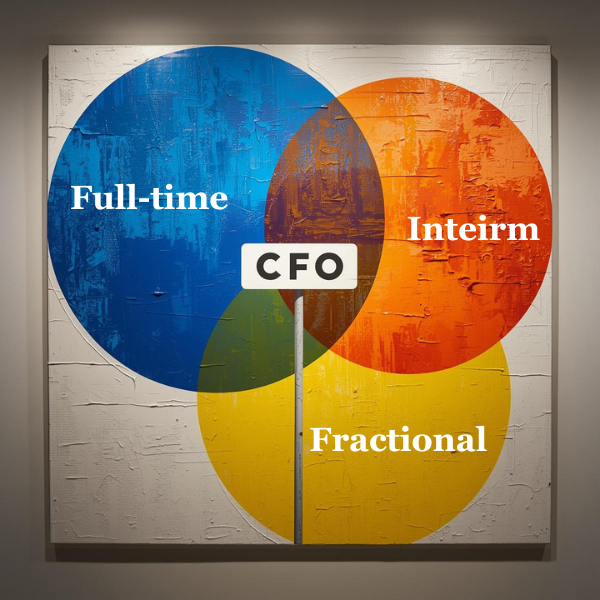
Types of CFO: which model fits your business?
Deciding to hire a CFO is only half the decision. The other half is choosing how you access that expertise. There are four main models, and the right one depends on your stage, budget and the intensity of your needs.
Full-time CFO
A permanent, salaried executive who lives and breathes your business every day. This is the right model for larger or complex businesses where the finance workload genuinely justifies a senior full-time salary, benefits and often equity. The cost is significant — frequently well into six figures once everything is added up — so the value must be there to match.
Fractional CFO
A fractional CFO is an experienced finance leader who works with you for a fraction of the time — typically a few days a month — while delivering full board-level expertise. This model has grown rapidly in the UK because it gives smaller and scaling businesses access to top-tier strategic finance at a fraction of the cost. If the term is new to you, our guide on what fractional CFO means explains it fully.
Part-time CFO
Closely related to the fractional model, a part-time CFO commits a set portion of their week to your business on an ongoing basis. The distinction is often one of degree and regularity rather than kind. Both give you senior expertise without a full-time salary.
Interim CFO
An interim CFO is usually full-time but temporary, brought in to cover a gap. A departure, a specific project, a period of transition — and then move on. This suits businesses with a defined, time-limited need rather than an ongoing one.
The Practical Reality
For the majority of UK SMEs and scale-ups, the honest first step is not a full-time CFO at all. It is fractional or part-time expertise, scaled precisely to what the business needs today.
Fractional vs full-time: making the call
For most growing businesses, the real decision is between fractional and full-time. The question comes down to workload, complexity and budget. If your finance needs genuinely fill a senior person’s week, full-time makes sense. If they do not, paying a full-time salary is simply overpaying for capacity you will not use.
A useful test is to estimate how many days a month of genuine CFO-level work your business requires. If the honest answer is a handful, fractional is almost certainly the better fit. As that number grows — often through a major fundraise, rapid scaling or exit preparation — the case for full-time strengthens. Many businesses travel exactly this path: fractional first, full-time later. For a detailed comparison, see our guide on fractional versus full-time CFO.
- Estimate the real CFO-level workload in days per month
- Weigh that against the fixed cost of a full-time salary
- Consider how quickly your needs are likely to grow
- Start with the lightest model that meets the need, and scale up

How much does it cost to hire a CFO?
Cost is often the deciding factor in when to hire a CFO. In how a founder brings that expertise on board. The good news is that the range is far wider than most people assume. The fractional model has made senior finance leadership accessible at almost any stage. Understanding what drives the cost helps you invest sensibly.
The full-time CFO cost
A full-time CFO in the UK commands a substantial salary, and that headline figure is only the start. Add employer costs, benefits, bonus and often equity, and the true annual commitment is considerably higher. For a business that genuinely needs full-time finance leadership, this is money well spent. For one that does not, it is a heavy and often premature burden.
The fractional CFO cost
A fractional CFO is priced around the time and scope you need — commonly a monthly retainer for an agreed number of days, a flexible day rate, or a project fee for a defined piece of work such as a raise or an exit. Because you pay only for a fraction of a CFO’s time, the cost is a fraction of a full-time salary while the expertise is the same. For a detailed breakdown of pricing models and what drives them, see our guide on how much a fractional CFO costs.
Cost Tip
A fractional CFO typically costs a fraction of a full-time salary while giving you the same board-level expertise. For most scaling UK businesses it is the most cost-effective route to finance leadership.
What drives the cost
- Scope — how many days per month you need
- Complexity — multiple entities, currencies or revenue streams
- Seniority and specialism — exit, fundraising or sector expertise
- Intensity — an active fundraise or sale needs far more time than steady-state oversight
Cost versus return: the only calculation that matters
Focusing purely on cost misses the point. The real question is return. A CFO who lifts your margins by a few percentage points, secures better funding terms, or adds meaningfully to your eventual sale price will typically deliver many times their fee in value. Judged on outcomes rather than hours, good CFO support is not an expense to minimise. It is an investment to optimise.
Reframe the Question
Do not ask whether you can afford a CFO. Ask what it is costing you not to have one — in missed margin, weaker fundraising and lost value at exit.
When to Hire a CFO for Maximum Business Value
Understanding the concrete ways a CFO creates value makes the timing decision far easier. Because once you see the return, the question shifts from “can we afford one?” to “how soon can we start?” Here are the high-leverage areas where a CFO earns their keep.
Cash flow forecasting and runway management
The most fundamental CFO contribution is making sure the business never runs out of money unexpectedly. A rolling cash forecast, updated regularly and stress-tested against different scenarios, gives you the foresight to act early. Arranging finance, adjusting spend or timing decisions — rather than lurching from one cash crisis to the next.
Margin and profitability improvement
A CFO interrogates where profit actually comes from. By analysing unit economics, pricing and cost structures, they identify which products, customers and channels create value and which destroy it. Small, disciplined improvements in margin compound powerfully over time and flow straight to the bottom line.
Fundraising and investor relations
When you raise, a CFO builds the model, defends the valuation, prepares the data room and fields the hard financial questions that founders often struggle with under pressure. This is frequently where a CFO delivers their most visible and immediate return, improving both the amount raised and the terms.
Strategic decision support
Every significant decision has a financial dimension, and a CFO makes that dimension explicit. They build the business cases, model the scenarios and quantify the trade-offs. The leadership team decides with clarity rather than instinct alone.
Exit readiness and valuation
For founders with a sale in mind, a CFO’s work on clean numbers, reduced risk and reduced founder dependence directly lifts the eventual price. This is long-horizon work, which is exactly why starting early pays off so handsomely.
Key Insight
A CFO does not just save money — they create it. Better margins, stronger fundraising and higher exit values routinely return several times the cost of the role.
When to Hire a CFO — and How to Choose the Right One
Once you have decided the timing is right, choosing the right person or partner matters enormously. A CFO becomes one of your closest advisers, so fit is as important as technical skill.
Define the outcome, not just the tasks
Start with what you want to achieve. A successful raise, healthier margins, a well-prepared exit — rather than a generic list of duties. The clearer the outcome, the easier it is to find someone whose experience matches it.
Look for relevant, specific experience
A CFO who has repeatedly done the exact thing you need. Raised at your stage, sold in your sector, scaled a business like yours — brings pattern recognition that generalist experience cannot match. Specific beats generic almost every time.
Prioritise communication and fit
The best CFO is one who can translate complex finance into clear choices for a non-financial founder. Who you genuinely trust as a sounding board. Technical brilliance is wasted if it cannot be communicated or if the working relationship does not click.
- Clarify the outcome you are hiring for
- Shortlist people with directly relevant experience
- Test communication and cultural fit early
- Start with a scope that matches your real priorities
- Review the impact regularly and scale the engagement as needs change
Mistakes to Avoid When You Hire a CFO
Even founders who understand the value of a CFO often stumble on execution. Avoiding these common mistakes will help you get the timing and the appointment right.
- Waiting for a crisis before hiring, when the value is greatest just before one
- Assuming CFO means full-time, and dismissing the far more accessible fractional option
- Confusing a CFO with a bookkeeper and hiring the wrong role for the problem
- Leaving exit preparation until a buyer appears, when value is built years earlier
- Choosing on cost alone rather than on the return the right person can deliver
- Hiring a generalist when the situation calls for specific fundraising or exit experience
The Biggest Mistake of All
The single most common regret founders express is not that they hired a CFO too early — it is that they waited too long.
Frequently asked questions
At what revenue should I hire a CFO?
There is no universal revenue threshold, because complexity matters more than turnover. That said, many UK businesses start needing genuine CFO-level input as they scale past early traction and approach their first significant fundraise. The trigger is usually a combination of growth, cash complexity and big decisions rather than a single revenue figure.
Do startups really need a CFO?
Early-stage startups rarely need a full-time CFO, but most benefit from CFO-level input — especially around fundraising and runway. The fractional model makes this affordable. Our guide on when a startup should hire a CFO covers the specific signals to watch for.
What is the difference between a CFO and an accountant?
An accountant records and reports the past and handles compliance; a CFO shapes the future through strategy, forecasting, fundraising and value creation. They are complementary, not interchangeable. Our overview of what a CFO does explains the distinction in full.
Can a fractional CFO really do the same job?
For most SMEs and scale-ups, yes. A fractional CFO brings the same seniority and expertise as a full-time hire. Often more, since many are highly experienced leaders running a portfolio of clients. What differs is the time commitment, not the quality of the thinking.
How long before a fundraise should I hire a CFO?
Ideally three to six months. That gives time to clean up historic numbers, build a robust model, test assumptions and prepare a data room before investor conversations begin. Our guide on CFO support for fundraising goes deeper on the process.
When should I hire a CFO if I plan to sell?
As early as possible — ideally two to three years before a sale. Exit value is built through clean numbers, reduced risk and reduced founder dependence, all of which take time. See our guide on the CFO’s role in exit planning for the detail.
Wondering if now is the right time for your business?
Let’s talk through where you are, the decisions ahead of you, and whether CFO support — full-time or fractional — could help you grow with confidence.
Get in touch →The founder’s journey: why finance becomes the bottleneck
To understand when to hire a CFO, it helps to understand why the need arises in the first place. In the beginning, a founder is the whole business. The salesperson, the product lead, the customer service team and, inevitably, the finance department. Decisions are fast, personal and driven by conviction. This works remarkably well at small scale. The founder holds the entire business in their head and can feel when something is off.
But businesses do not stay small if they succeed. As revenue grows and the organisation expands, the number of financial decisions multiplies and their consequences grow heavier. The founder who once tracked cash on the back of an envelope now oversees payroll for a growing team, negotiates with suppliers on credit terms, manages tax obligations across multiple periods. Fields questions from investors or lenders. The very instinct that served them so well early on begins to strain under the weight of complexity.
This is the moment finance quietly becomes the bottleneck. Not because the founder lacks ability. Because no single person can simultaneously run a growing business and provide it with sophisticated financial leadership. The choice is stark: either the founder spends more and more time on finance and less on the things only they can do, or financial decisions get made with less rigour than they deserve. Neither is sustainable, and both are signals that the time to hire a CFO is approaching.
The Bottleneck Signal
When the founder becomes the constraint on financial decision-making — either through lack of time or lack of specialist depth — the business has reached the point where a CFO changes everything.
The psychology of delaying
Founders delay hiring a CFO for understandable reasons. There is the cost, of course, but often the deeper resistance is emotional. Handing over the finances can feel like ceding control of the business’s nervous system. Many founders have built their company through hard-won intuition and are reluctant to admit that intuition alone is no longer enough. Others simply do not know what a CFO would do day to day, and so cannot picture the value.
Recognising this psychology is useful, because it explains why so many founders hire too late. The rational case for a CFO usually arrives well before the emotional readiness to make the hire. The founders who scale most smoothly are those who override that hesitation and bring in financial leadership while the business still has room to breathe, rather than in the middle of a cash crisis or a stalled fundraise.
How a CFO thinks differently from a founder
One of the most valuable things a CFO brings is a genuinely different way of thinking. Founders tend to be optimists by necessity. You cannot start a business without believing in a future most people cannot see. That optimism is a superpower, but it has a shadow: it can lead to rosy forecasts, underpriced offers and underestimated risks. A good CFO provides the essential counterbalance.
Where a founder sees opportunity, a CFO also sees the cash required to pursue it and the risk if it does not land. Where a founder sees a big new contract, a CFO sees the working capital needed to deliver it and the concentration risk of relying on one large customer. This is not pessimism; it is completeness. The best founder-CFO relationships are a productive tension between vision and rigour, ambition and discipline.
Vision Meets Rigour
A founder asks “how big could this be?” A CFO asks “what will it cost, what could go wrong, and can we fund it?” Together, those two questions produce far better decisions than either alone.
Turning numbers into narrative
A further skill the CFO brings is translation. Raw financial data is meaningless to most people, including many founders. The CFO’s job is to turn that data into a narrative — a clear story about what is happening in the business, why. What to do about it. This narrative is what founders use to make decisions, what investors use to write cheques. What buyers use to justify a price. A CFO who can tell the financial story of a business clearly and credibly is worth far more than one who merely produces accurate spreadsheets.

A closer look at cash flow: the reason most businesses fail
If there is one area where a CFO justifies their existence beyond all doubt, it is cash flow. The statistic that haunts every founder is that the majority of business failures are caused not by lack of profit but by lack of cash. A business can be growing, winning customers and booking profit on paper. Still collapse because there is not enough money in the bank on the day a bill falls due.
This happens because profit and cash move on different timelines. You might win a large contract that will be highly profitable over the year. If you have to pay for materials and staff up front while the customer pays you sixty days later, the gap between outflow and inflow can sink you. Growth actually makes this worse, not better. The faster you grow, the more cash you tie up in the gap between spending and getting paid. This is the cruel paradox that catches so many successful-looking businesses off guard.
The Growth Paradox
Fast growth consumes cash. The more successful you are at winning business, the more cash you tie up delivering it — which is why so many growing companies hit a cash wall just as things seem to be going brilliantly.
What a CFO does about cash
A CFO attacks the cash problem on several fronts at once. First, they build a rolling forecast that projects cash weeks and months ahead. You can see a squeeze coming with enough time to act. Second, they work on the drivers of cash: tightening the time it takes customers to pay, negotiating better terms with suppliers. Managing stock so money is not needlessly frozen in inventory. Third, they arrange the right financing before it is needed, rather than scrambling for expensive money in an emergency.
The difference this makes is profound. A business with proper cash management runs with calm confidence, making growth decisions from a position of strength. A business without it lurches from one near-miss to the next, with the founder perpetually anxious about the bank balance. Moving from the second state to the first is often the single most immediate benefit founders notice after bringing in a CFO.
Scenario planning and resilience
Beyond the base forecast, a CFO builds scenarios: what happens if a major customer leaves, if sales fall short, if a big opportunity requires sudden investment? By modelling these in advance, the business is never caught completely unprepared. This resilience proved its worth for countless businesses during recent economic shocks, where those with strong financial planning navigated turbulence far better than those flying blind.
Why This Matters
Cash forecasting is not an accounting nicety. It is the early-warning system that gives a founder the time to act before a problem becomes a crisis.
Reporting and KPIs: seeing the business clearly
Another area where a CFO transforms a business is management reporting. Many founders operate with either too little information or too much of the wrong kind. They may have a bank balance and a rough sense of sales. No clear view of the metrics that actually predict the health and direction of the business. A CFO fixes this by designing reporting around the handful of numbers that truly matter.
These key performance indicators vary by business. The discipline is universal: identify the few metrics that drive value, measure them accurately, and review them regularly. For one business the critical numbers might be customer acquisition cost and lifetime value; for another, gross margin by product line; for a third, cash conversion and order backlog. The CFO’s skill lies in choosing the right indicators and presenting them so the leadership team can act on them at a glance.
- Timely reporting — available days, not weeks, after period end
- Relevant metrics — the few numbers that genuinely drive the business
- Forward-looking indicators, not just historic results
- Clear presentation that a non-financial founder can act on immediately
- Consistency, so trends and changes are easy to spot over time
Good reporting changes the entire tenor of how a business is run. Instead of reacting to problems after they show up in the bank account, the leadership team spots issues early in the leading indicators and acts while there is still time. This shift from reactive to proactive management is one of the quiet but powerful contributions a CFO makes.
Fundraising in depth: how a CFO changes the odds
Fundraising deserves a closer look, because it is one of the moments when the presence or absence of a CFO has the most dramatic effect on outcomes. Raising investment is a high-stakes, high-scrutiny process in which the quality of your financial story directly determines how much you raise, at what valuation, and on what terms. Founders who go in underprepared frequently raise less, give away more equity, or fail to close at all.
The reason is simple: experienced investors have seen thousands of pitches and can spot weak financial thinking instantly. An over-optimistic model, an assumption that does not hold up, a cash runway that does not reconcile — any of these erodes confidence. Confidence is the currency of fundraising. A CFO ensures your numbers do not just survive scrutiny but actively build the investor’s conviction that you are a founder who understands and controls the business.
The Confidence Equation
Investors fund founders who understand their numbers. Nothing accelerates a raise faster than a founder who can defend the model line by line, with a CFO alongside to handle the technical depth.
Building the investor-ready model
At the heart of any raise is the financial model. A CFO builds one that is bottom-up and driver-based, meaning every projection traces back to real, defensible assumptions about how the business grows. This is a world away from the optimistic top-down model. Pick a big market, assume a small share, draw a hockey stick — that experienced investors dismiss on sight. A credible model shows you understand the mechanics of your own growth. That understanding is precisely what investors are buying.
Valuation and negotiation
A CFO also helps frame and defend your valuation. Valuation is part evidence and part negotiation. A founder who can ground their ask in comparable deals, sensible metrics and a credible growth story is in a far stronger position than one who has simply picked a number they like. During the negotiation itself, a CFO understands the terms behind the headline valuation. The liquidation preferences, option pools and other provisions that can matter as much as the price — and helps ensure you do not win on valuation while losing on terms.
Diligence and the data room
Once a term sheet is agreed, due diligence begins, and this is where deals are frequently delayed or lost. A CFO prepares a clean, complete data room in advance — financials, contracts, cap table, key metrics — so that when the investor’s advisers start digging, they find order rather than chaos. A smooth diligence process maintains momentum and confidence right through to the money landing in your account. Our dedicated guide on CFO support for fundraising in the UK explores each of these stages in greater depth.
The UK Funding Reality
UK investors and lenders increasingly expect finance leadership even at early stages. Bringing a fractional CFO to your raise signals maturity and materially improves both your odds and your terms.

Exit and valuation in depth: building the number that matters most
For many founders, the ultimate purpose of building a business is the eventual exit. The moment years of effort convert into a life-changing sum. Yet this is precisely the area where founders most often leave money on the table. Exit value is not created at the point of sale. It is built, painstakingly, in the years beforehand. A CFO who joins early enough can have an enormous impact on the final number.
The value of a business at exit is usually a function of two things: a measure of profit, most often adjusted EBITDA. A multiple applied to that profit. A CFO works on both. On the profit side, they improve margins, remove one-off costs and present a clean, credible earnings figure that a buyer will accept without heavy discounting. On the multiple side, they reduce the risks and increase the quality signals. Recurring revenue, customer diversification, strong systems, reliable forecasting — that persuade a buyer to pay a premium rather than demand a discount.
The Value Gap
The difference between what a founder believes the business is worth and what a buyer will actually pay is often vast. A CFO’s job is to close that gap in the years before you go to market — not to discover it during the sale.
Reducing founder dependence
One of the most important and overlooked drivers of exit value is founder dependence. If a business cannot function without its founder, a buyer sees enormous risk. The very person they are buying is planning to leave. A CFO helps build the management, processes and reporting that allow the business to run without the founder’s daily involvement. This not only lifts the valuation but also makes the deal far more likely to complete on good terms.
Deal structure and after-tax outcome
Finally, a CFO helps navigate the structure of the deal itself. The headline price is only part of the story; how the deal is structured — cash versus deferred consideration, earn-outs, the tax treatment — determines what you actually keep. A CFO models these structures so you understand your genuine after-tax outcome and can negotiate accordingly. Our guide on the CFO’s role in exit planning and valuation covers this territory in detail.
Industry differences: when to hire a CFO in different sectors
While the principles of CFO timing are universal, the specifics vary considerably by sector. Understanding the particular financial dynamics of your industry helps you judge when the need becomes pressing.
Technology and SaaS
Technology businesses, especially those built on recurring subscription revenue, tend to need CFO-level thinking early. The metrics that drive value — recurring revenue, churn, customer acquisition cost, lifetime value and cash burn — are financial at their core. Getting them right is essential both for running the business and for raising the capital these companies typically depend on. A SaaS founder approaching a serious raise almost always benefits from a CFO.
Manufacturing and product businesses
Businesses that make and sell physical products face intense working-capital pressures. Money is tied up in raw materials, work in progress and finished stock long before customers pay. The gap between spending and getting paid can be brutal, and managing it well is a specialist financial skill. For these businesses, a CFO’s cash and inventory expertise is often the difference between healthy growth and a cash crisis.
Professional services
Service businesses live and die by utilisation, pricing and the timing of billing and collection. Because their main cost is people. People are largely fixed in the short term, margin discipline and accurate forecasting of workload and revenue are critical. A CFO helps service firms price properly, manage capacity and avoid the feast-and-famine cash cycles that plague the sector.
Retail and e-commerce
Retailers and online sellers juggle thin margins, seasonal swings and significant investment in stock. Understanding true profitability by product and channel. After all the hidden costs of fulfilment, returns and marketing — is surprisingly hard and frequently done badly. A CFO brings the analytical rigour to see where money is genuinely made. In a low-margin business can be the difference between thriving and merely surviving.
Sector Nuance
Every industry has its own financial pressure points. The best CFO for your business is one who understands the specific dynamics of your sector, not just finance in the abstract.
The relationship between founder and CFO
It is worth dwelling on the human side of this decision. A CFO is not just a function you buy but a relationship you enter. The most successful founder-CFO partnerships share certain qualities. Understanding them helps you both choose the right person and get the most from them once they are in place.
The first quality is trust. A CFO will know the business’s finances intimately, including its vulnerabilities. Will sometimes have to deliver news the founder does not want to hear. This only works if the founder trusts the CFO’s judgement and integrity completely. The second quality is candour. A CFO who simply tells the founder what they want to hear is worse than useless; the value lies precisely in the honest, sometimes uncomfortable, perspective they bring. The third is communication — the ability to translate complex finance into clear choices. To do so in a way that respects the founder’s intelligence without assuming financial expertise.
The Partnership Test
The right CFO is someone you trust enough to hear hard truths from, and who explains the numbers so clearly that you always understand the choice in front of you.
Making the relationship work from day one
Even the best CFO cannot help a business that keeps them at arm’s length. To get full value, founders should give their CFO genuine access. To data, to the leadership team, and to themselves. The CFO should be part of strategic conversations, not summoned only when there is a problem. And the engagement should be reviewed openly and regularly, with the scope flexing as the business’s needs change. A fractional CFO in particular can scale up during intense periods like a fundraise and scale back in quieter times. This only works if the relationship is close enough for both sides to judge the need honestly.
- Give the CFO full access to data and to you
- Include them in strategic conversations, not just crises
- Be honest about problems — a CFO cannot fix what they cannot see
- Review the impact and the scope openly and regularly
- Flex the engagement up and down as the business’s needs change
A Practical Framework for When to Hire a CFO
Bringing all of this together, here is a practical way to work through the decision of when to hire a CFO and how to do it well. Rather than a rigid formula, think of it as a sequence of honest questions that lead you to the right answer for your specific situation.
Step one: assess the pressure
Start by counting how many of the classic signals apply to you right now. Is growth outpacing your visibility? Does cash worry you? Is a fundraise or exit approaching? Are margins slipping? Do big decisions feel like guesses? Is finance eating your time? If two or more ring true, the need is real and present. If only one applies, you may have a little more runway, but keep watching.
Step two: define the outcome
Next, be specific about what you would want a CFO to achieve. A successful raise? Healthier margins? A well-prepared exit? Calmer cash management? Better decision-making? The clearer your desired outcome, the easier the rest of the decision becomes. It points directly to the kind of experience you should look for.
Step three: estimate the workload
Now estimate, honestly, how many days a month of genuine CFO-level work your business needs. A handful of days points clearly to a fractional arrangement. A workload that fills most of a senior person’s week points towards full-time. Being realistic here saves you from either overpaying for capacity you will not use or underserving a genuine need.
Step four: match the model to the stage
Combine your workload estimate with your stage and budget to choose the model. Early-stage and lean? Fractional or project-based. Scaling with rising complexity? Fractional moving towards part-time or full-time as the workload grows. Established and heading for exit? Whatever level of support gets the business genuinely diligence-ready. Our comparison of fractional versus full-time CFO helps you weigh the final choice.
Step five: judge on return, not cost
Finally, evaluate the decision through the lens of return rather than cost. Ask what a CFO could realistically add. In margin, in funding, in eventual sale value — and weigh that against the fee. For the vast majority of growing businesses that genuinely need one, the return dwarfs the cost. The main risk is not spending too much but waiting too long.
The Framework in a Sentence
Count the pressures, define the outcome, estimate the workload, match the model to your stage, and judge the whole thing on return rather than cost.
More questions founders ask
Is it too early to hire a CFO if we are pre-revenue?
Usually a full-time CFO is too early pre-revenue, but CFO-level input rarely is — particularly if you are raising. Project-based or light fractional support can build your first model and get your finances investor-ready without the cost of a permanent hire.
Can I promote my financial controller to CFO instead?
Sometimes, but not always. A financial controller runs the finance function superbly. Is a different skill from setting financial strategy, leading a fundraise or preparing an exit. Some controllers grow into the strategic role; others are brilliant at what they do but not suited to it. Be honest about which you have before assuming a promotion solves the problem.
How quickly will a CFO add value?
Often faster than founders expect. In the first weeks a good CFO typically brings clarity to cash and reporting; within a few months the effects on margins, decisions and fundraising readiness become visible. The compounding, long-horizon value — particularly on exit — builds over the years that follow.
What if I cannot afford a CFO at all yet?
Then the fractional or project model is almost certainly your answer. It scales the cost down to what you can genuinely support. Even a day or two a month of senior input can transform how a small business manages cash and makes decisions. The point is that lack of budget rarely means you must go without CFO thinking entirely. Only that you access it differently.
What good looks like: three founder scenarios
Abstract principles are useful, but the decision of when to hire a CFO becomes clearer through concrete situations. The following scenarios are composites drawn from the kinds of businesses that most often reach this crossroads. They are illustrative rather than specific, but the patterns will feel familiar to many founders.
The scaling founder hitting a cash wall
Consider a founder whose business has grown quickly for three years. Revenue is up strongly, the team has doubled, and by every external measure the company is a success. Yet the founder is increasingly anxious. Despite the growth, cash always feels tight. A recent large contract — cause for celebration — has actually made the squeeze worse, because it requires significant upfront spending before payment arrives. The founder is spending evenings wrestling with spreadsheets and still cannot answer, with confidence, whether the business can afford its next planned hire.
This is a textbook case for a CFO, and specifically for the cash-management expertise a CFO brings. Within weeks, a CFO in this situation would typically build a rolling cash forecast that reveals exactly when the pressure points fall, renegotiate payment terms to ease the strain. Arrange appropriate financing to bridge the growth gap. Just as importantly, the founder gets their evenings back and can return to the work that actually grows the business. The transformation here is as much psychological as financial — replacing constant anxiety with genuine control.
The founder preparing for a first institutional raise
Now consider a founder approaching their first serious funding round. The product has traction, the market is large, and investors are interested. But the founder has never raised institutional money before. The financial model is a well-intentioned but fragile spreadsheet built in the early days. In investor meetings, the founder can talk brilliantly about vision but stumbles when the questions turn technical: burn rate, unit economics, the assumptions behind the growth curve.
Bringing in a fractional CFO several months before the raise changes the entire trajectory. The CFO rebuilds the model on solid, defensible foundations, prepares the founder for the hard questions, assembles a clean data room, and often joins key meetings to handle the financial depth. The result is a founder who walks into the room prepared, an investor whose confidence is built rather than eroded, and typically a raise that closes faster and on better terms. Our guide on CFO support for fundraising walks through exactly this journey.
The founder planning an exit in three years
Finally, consider a founder in their fifties who has built a solid, profitable business over two decades and now has one eye on retirement. They imagine selling in around three years. It would be easy to assume there is nothing to do yet — but this is precisely the moment a CFO adds the most value. Exit value is built over exactly this kind of horizon.
A CFO joining now would begin cleaning up the financials so they will withstand a buyer’s scrutiny, work to reduce the business’s dependence on the founder, sharpen margins and reporting, and start positioning the business for the kind of buyer most likely to pay a premium. Three years of this preparation can add substantially to the final sale price — often many multiples of the CFO’s cost. The founder who waits until a buyer appears, by contrast, negotiates from a position of weakness with whatever numbers happen to exist. Our guide on the CFO’s role in exit planning explains why this lead time matters so much.
The Common Thread
In every scenario, the value comes from acting before the pressure peaks. The founders who benefit most are those who bring in a CFO while they still have room to manoeuvre.
Debunking the myths that stop founders hiring
A number of persistent myths lead founders to delay or dismiss the idea of a CFO. It is worth confronting them directly, because each one causes real businesses to leave value on the table.
Myth: a CFO is only for big companies
This was once true and is now firmly outdated. The rise of the fractional model has put CFO-level expertise within reach of businesses of almost any size. A small company can access a highly experienced CFO for a few days a month, gaining the strategic benefit without the corporate cost. The idea that finance leadership is a luxury reserved for large corporates simply no longer holds.
Myth: my accountant does everything a CFO would
Accountants are essential, but they solve a different problem. They ensure compliance and record what has happened; a CFO shapes what happens next. Expecting your accountant to provide strategic financial leadership is like expecting your GP to perform specialist surgery — related fields, but distinct skills. The two roles complement each other rather than substitute for one another. Our overview of what a CFO actually does draws out the difference.
Myth: I cannot afford a CFO
This confuses the full-time cost with the only option. A full-time CFO is indeed a significant commitment, but it is far from the only route. Fractional and project-based models scale the cost to what a business can support. When judged on return rather than raw cost, good CFO support typically pays for itself many times over. The more accurate worry, for most growing businesses, is what it costs not to have one.
Myth: hiring a CFO means losing control
Many founders fear that bringing in a CFO means handing over the reins. In reality, a good CFO gives founders more control, not less — because control comes from understanding. A CFO makes the finances of the business genuinely understandable. The founder remains the decision-maker; the CFO simply ensures those decisions are made with clarity rather than in the dark.
The Truth Behind the Myths
Nearly every reason founders give for not hiring a CFO dissolves under examination. The fractional model has quietly removed the barriers that used to make sense a decade ago.
The fractional model in practice
Because the fractional CFO has become the default first step for so many UK businesses, it is worth understanding how the arrangement actually works day to day. The mental picture some founders have — of a distant consultant who drops in occasionally — is misleading. A good fractional CFO becomes a genuine part of the leadership rhythm, just at a different cadence from a full-time hire.
In practice, a fractional CFO typically agrees a regular commitment. A set number of days each month — supplemented by availability for the inevitable questions and decisions that arise between visits. They join the key strategic meetings, own the financial reporting and forecasting cycle. Lead on major projects such as a fundraise or an exit when those arise. The relationship is ongoing rather than transactional, which is what distinguishes it from one-off consultancy.
Fractional, Not Absent
A fractional CFO is part-time in hours but full-time in commitment to your business. The good ones are as invested in your success as any permanent hire.
The flexibility advantage
The great strength of the fractional model is its flexibility. Business needs are rarely constant: some months are quiet, others — a raise, a big decision, year-end — are intense. A fractional arrangement flexes with these rhythms, scaling up when the pressure is on and back down when it eases. This means you pay for the expertise in proportion to your genuine need, rather than carrying a fixed cost through the quiet periods. For a business with uneven or seasonal demands on its finance function, this flexibility is enormously valuable.
Access to broader experience
There is a further, less obvious benefit. Because a fractional CFO works with several businesses, they bring a breadth of pattern recognition that a single-company CFO cannot. They have seen how different businesses have solved the problem you are facing, navigated the raise you are attempting, or prepared for the exit you are contemplating. This cross-pollination of experience is a genuine advantage of the model, not merely a consolation for its part-time nature. If you would like a fuller picture of the model, our guide on what a fractional CFO means explains it in plain English, and our piece on what a fractional CFO costs addresses the economics.
Building financial foundations before you need them
A recurring theme throughout this guide is the value of acting early. It is worth drawing that theme together into a clear principle. The greatest returns from financial leadership come not from firefighting but from foundation-building. The unglamorous work of getting cash forecasting, reporting, margins and systems right before a crisis or an opportunity forces the issue.
This is because financial foundations compound. Clean reporting established today makes every future decision better. A cash forecast built now prevents the crisis that would otherwise strike in six months. Exit preparation begun this year adds value that accumulates until the day you sell. The founder who invests in these foundations early is not spending money; they are planting something that grows. The founder who waits until the foundations are urgently needed pays more, gets less, and does so under pressure.
The Compounding Principle
Financial foundations built early compound in value over time. The best moment to establish them was at the last inflection point; the second-best moment is now.
A checklist of foundations worth building
- A rolling cash flow forecast, regularly updated and stress-tested
- Timely, relevant management reporting built around the right KPIs
- A clear understanding of margins and unit economics by product and channel
- A financial model that can flex to test decisions and scenarios
- Clean, credible historic accounts ready for any investor or buyer
- Systems and processes that reduce reliance on the founder
None of these is glamorous, and none delivers an instant headline result. But together they form the bedrock on which confident growth, successful fundraising and valuable exits are built. Establishing them is precisely the work a CFO exists to do. The reason so many founders, looking back, wish they had brought one in sooner.
Measuring the impact of a CFO
Founders rightly want to know that an investment in financial leadership is paying off. The good news is that a CFO’s impact, while sometimes indirect, is genuinely measurable if you know what to look for. Setting expectations and tracking outcomes from the outset turns a vague sense of value into a clear picture of return.
The most immediate impact usually shows up in cash and clarity. Within the first few months you should see a reliable cash forecast where there was none, faster and more trustworthy reporting. A founder who can answer financial questions with confidence rather than guesswork. These early wins are qualitative but unmistakable, and they matter enormously for the founder’s peace of mind and decision quality.
Over the following months and years, the impact becomes more quantitative. Margins should improve as pricing and cost discipline take hold. Cash should be managed so that expensive emergency financing becomes unnecessary. Fundraises should close faster and on better terms. And, for those heading towards a sale, the eventual valuation should reflect the years of preparation. Each of these can be measured against where the business was before. In almost every case the value created dwarfs the cost of the role.
Measuring Return
Track three things: the clarity a CFO brings to decisions, the cash and margin improvements they drive, and the value they add at fundraising or exit. On all three, good CFOs typically return several times their fee.
Setting expectations from the start
The best way to ensure you get value is to agree, at the outset, what success looks like. Is it a successful raise within twelve months? A margin improvement of a defined amount? A business that is genuinely diligence-ready by a certain date? Clear objectives focus the CFO’s work and give you a concrete benchmark against which to judge the engagement. Vague expectations, by contrast, produce vague results and make it hard to know whether the investment is working.
Financial strategy beyond the numbers
It would be a mistake to think of a CFO purely in terms of spreadsheets and forecasts. The most valuable contribution a CFO makes is often strategic: helping the founder and the leadership team think clearly about the direction of the business and the financial choices that direction implies. Every strategic decision — which markets to enter, which products to build, whether to grow organically or through acquisition — has a financial dimension. A CFO ensures that dimension is properly understood.
This strategic role is why the modern CFO sits alongside the CEO rather than beneath them in the hierarchy of decision-making. The CEO brings vision and drive; the CFO brings the financial lens that turns ambition into a viable plan. When the two work well together, the business gets the best of both — bold goals pursued with financial discipline. When a business lacks this partnership, it tends either towards reckless ambition that outruns its resources or towards timid caution that squanders opportunity.
Strategy and Finance Are Inseparable
Every major strategic choice is also a financial choice. A CFO ensures the business pursues its ambitions in a way it can actually afford and sustain.
Capital allocation: the art of where to spend
One of the most consequential strategic questions any business faces is capital allocation. How to deploy its limited resources for the greatest return. Should profits be reinvested in growth, used to pay down debt, held as a cash buffer, or returned to shareholders? Should the next pound go into marketing, product, hiring or acquisition? These are among the most important decisions a business makes. They are precisely the decisions a CFO is trained to help with. A disciplined approach to capital allocation, guided by clear analysis of expected returns, is one of the quiet hallmarks of a well-run company.
Working capital: the hidden engine
Earlier we touched on cash flow; working capital deserves its own treatment. It is one of the least understood yet most important levers a CFO can pull. Working capital is, in essence, the money tied up in the day-to-day running of the business. In stock waiting to be sold, in invoices waiting to be paid by customers, offset by the money the business itself owes to suppliers. Manage it well and cash is freed up to fund growth; manage it badly and the business is perpetually starved of cash despite being profitable.
A CFO works systematically to optimise each component. On the customer side, they tighten credit terms and collection processes so money arrives sooner. With suppliers, they negotiate terms that let the business hold onto its cash longer without damaging relationships. When it comes to stock, they ensure the business holds enough to operate but not so much that cash is needlessly frozen. Small improvements in each of these areas can release surprisingly large sums, effectively funding growth from within rather than through expensive external finance.
The Free Funding Source
Optimised working capital is like an interest-free loan hidden inside your own business. A CFO’s work here often releases cash that would otherwise have to be borrowed at a cost.
Why working capital worsens with growth
The counterintuitive truth, worth repeating because it catches so many founders out, is that growth consumes working capital. The faster you grow, the more stock you must hold, the more customer invoices you are waiting on. The more cash is tied up in the gap. This is why rapidly growing businesses so often hit a cash crisis at the very moment they appear most successful. A CFO who understands this dynamic plans for it in advance, ensuring the business has the cash to fund its own growth rather than being throttled by it.
Risk management and financial resilience
A further dimension of the CFO’s role, often invisible until it is needed, is risk management. Every business faces financial risks — a key customer that might leave, a currency that might move, a cost that might spike, an economic downturn that might arrive. Most founders are so focused on growth that these risks receive little attention until one of them materialises. A CFO brings them into the open and puts plans in place to manage them.
This is not about pessimism or excessive caution; it is about resilience. A business that has thought through its risks and prepared for them can take bolder growth decisions precisely because it has a safety net. It can weather shocks that would sink an unprepared competitor. It can seize opportunities during downturns when others are merely surviving. The businesses that came through recent economic turbulence in the strongest position were overwhelmingly those with robust financial planning and a clear-eyed view of their risks.
Resilience Enables Ambition
Managing risk is not the enemy of growth — it is what makes bold growth safe. A business that understands its risks can push harder, not softer.
The role of scenario planning
The practical tool a CFO uses here is scenario planning. Modelling how the business would fare under a range of possible futures, both good and bad. What happens if sales fall short by a fifth? If the largest customer leaves? If a sudden opportunity requires rapid investment? By working through these scenarios before they happen, the business is never caught entirely off guard. The leadership team has already thought about how it would respond. This preparation converts potential crises into manageable situations. It is one of the most valuable and least visible things a CFO does.
When to Hire a CFO in a Changing Finance Landscape
It is worth reflecting briefly on how the role continues to change, because it affects what founders should look for. The CFO of the past was largely a steward. A guardian of the numbers, focused on control, compliance and reporting. The CFO of today is far more of a strategist and a partner, focused on value creation, growth and the big decisions that shape the business’s future. Technology has driven much of this shift, automating the routine work and freeing the CFO to focus on what only a skilled human can do: judgement, strategy and relationships.
For founders, this evolution means the CFO you hire should be chosen as much for their strategic and commercial instincts as for their technical financial skill. The technical foundation is essential and assumed, but the differentiating value lies in the ability to think strategically, communicate clearly. Partner genuinely with the founder. When you assess a potential CFO, weigh these qualities heavily. They are what separates a CFO who merely keeps the score from one who helps you win the game.
Choose for Judgement
Technical skill is the entry ticket. The CFOs who transform businesses are chosen for strategic judgement, clear communication and genuine partnership.
Bringing it all together
We have covered a great deal of ground, from the signs that the moment has arrived, through the different models and their costs, to the many ways a CFO drives value across cash, margins, fundraising, exit and strategy. If a single message runs through all of it, it is this: knowing when to hire a CFO matters because financial leadership is not a cost to be minimised but an investment to be timed well and chosen wisely.
The founders who build the most valuable, resilient and successful businesses tend to treat finance not as a back-office necessity but as a central driver of strategy. They bring in financial leadership before they are forced to, choose it in a form that matches their stage and budget. Judge it on the return it delivers rather than the cost it incurs. For the vast majority of growing UK businesses, that leadership arrives first in fractional form and grows with the company from there.
Wherever you are on that journey, the questions in this guide should help you locate yourself and decide your next move. If two or more of the signs feel familiar, if a fundraise or exit is on your horizon, or if finance has quietly become the thing that keeps you awake, then the moment to act is not somewhere in the future. It is now.
The first ninety days with a new CFO
Once you have decided the timing is right and chosen the right person, the early weeks set the tone for everything that follows. Understanding what a good CFO does in their first ninety days helps you support them and recognise whether the engagement is on track.
Weeks one to four: understanding and stabilising
A good CFO spends the first month immersing themselves in the business. Understanding how it makes money, where the cash goes, what the current reporting shows and, crucially, what it does not. They will typically build or repair the cash forecast as a first priority. Visibility over cash is the foundation for everything else. By the end of the first month you should already feel a noticeable increase in clarity, even if the deeper work has barely begun.
Weeks five to eight: diagnosing and prioritising
With the basics understood, the CFO turns to diagnosis: where are the margins leaking, which decisions are being made blind, what risks are lurking. What opportunities are being missed? From this diagnosis comes a prioritised plan. The handful of things that will make the biggest difference, tackled in a sensible order. This is where the founder should engage closely. Agreeing priorities together ensures the CFO’s work is aimed squarely at what matters most to the business.
Weeks nine to twelve: building and delivering
In the final month of the first quarter, the CFO moves from diagnosis to delivery — establishing the reporting that will run from now on, implementing the first margin or cash improvements. Laying the groundwork for any major project such as a raise or exit. By the ninety-day mark you should have a clear cash picture, meaningful reporting, an agreed set of priorities and visible early progress. If you have those, the engagement is on track.
The 90-Day Test
After three months, a good CFO should have delivered clarity on cash, meaningful reporting, an agreed plan and visible early wins. If they have, you have made the right hire.
How the founder can help
- Give the CFO fast access to data, systems and people
- Be honest about problems rather than presenting a rosy picture
- Agree priorities together rather than dictating or abdicating
- Protect time for the CFO in strategic conversations
- Give the relationship room to develop — trust builds over months
A final word on timing
If there is one idea to carry away from this guide, it is that the question is rarely whether your growing business will benefit from a CFO. It almost certainly will — but when and in what form. The signs are usually there well before founders act on them: the cash anxiety, the decisions that feel like guesses, the fundraise or exit on the horizon, the sense that finance has become a bottleneck rather than a strength. The businesses that thrive are those that read these signs early and respond, choosing a model that fits their stage and a person they trust.
Financial leadership, timed and chosen well, is one of the great multipliers of business value. It turns cash from a worry into a tool, decisions from guesses into calculations, fundraises from ordeals into opportunities. Exits from hopeful sales into well-earned rewards. Whether that leadership arrives as a fractional CFO a few days a month or a full-time hire, the principle is the same: bring it in before you desperately need it. It will repay you many times over. That, in the end, is the answer to the question of when to hire a CFO — a little sooner than feels comfortable. Far sooner than you might fear.
Conclusion: timing is everything
Knowing when to hire a CFO comes down to honest self-assessment. If growth is outpacing your visibility, cash keeps you awake, a fundraise or exit is on the horizon, or big decisions feel like guesses, the moment has almost certainly arrived. The form that leadership takes — fractional, part-time or full-time — should match your stage and budget. For most growing UK businesses the fractional route is the natural first step.
The founders who build the most valuable businesses tend to share one habit: they bring in financial leadership just before they need it, not long after. Get the timing right, choose the right person. A CFO stops being a cost on the balance sheet and becomes one of the most powerful drivers of value your business will ever have.
Explore the full CFO hiring cluster
- Why Every Business Needs a CFO (Not Just a Bookkeeper)
- Do I Need a CFO? 8 Signs Your Business Is Ready
- What Does “Fractional CFO” Mean? A Plain-English Guide
- How Much Does a Fractional CFO Cost — and Is It Worth It?
- CFO Support for Fundraising: Raising With Confidence
- How to Sell to the CFO: A B2B Founder’s Guide
- The CFO’s Role in Exit Planning and Business Valuation

Written by
Liz Bell
Liz Bell is the founder of Liz Bell Consulting and the driving force behind a growing community of Chief Financial Officers. She champions a data-driven, strategic and reliable approach to CFO services, helping founders scale smarter, raise with confidence, and build businesses that endure.
Learn more about Liz →Think your business is ready? Get matched with a vetted UK finance leader from our community of 130+ CFOs — free and with no obligation. hire a CFO with Liz Bell Consulting.